
At 7:00 a.m. on August 15, 2020, following the detonation command, Qinjiang Bridge in Kaihua County, Quzhou collapsed onto the riverbed in place as designed. The surrounding buildings and facilities remained intact, and the blasting demolition was successfully completed. Classified as a Grade A demolition blasting project, the project’s blasting design and construction were undertaken by our company.
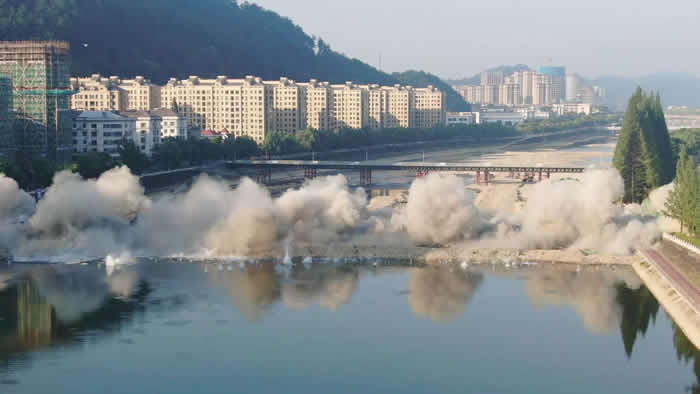
Qinjiang Bridge is a 220-meter-long masonry double-curvature open-spandrel arch bridge, which was completed and opened to traffic on October 1, 1978. Over more than four decades of safe operation, the bridge not only supported urban transportation in Kaihua County but also carried the memories and emotions of generations of local residents.
With the continued development of urbanization, traffic demand in downtown Kaihua has increased significantly, and Qinjiang Bridge could no longer meet current transportation requirements. According to inspections conducted by professional institutions, the main structure of the bridge no longer satisfied the original design load requirements. Therefore, the County Party Committee and County Government decided to demolish and rebuild the bridge.

Within a 100-meter radius on both the east and west sides of the bridge, there were buildings including the county government office building, residential buildings, and residential buildings under construction. A new bridge pile foundation was located approximately 6 meters from the southern side of the river channel, while the main underground water supply pipeline was directly beneath the east abutment. The surrounding environment was extremely complex.
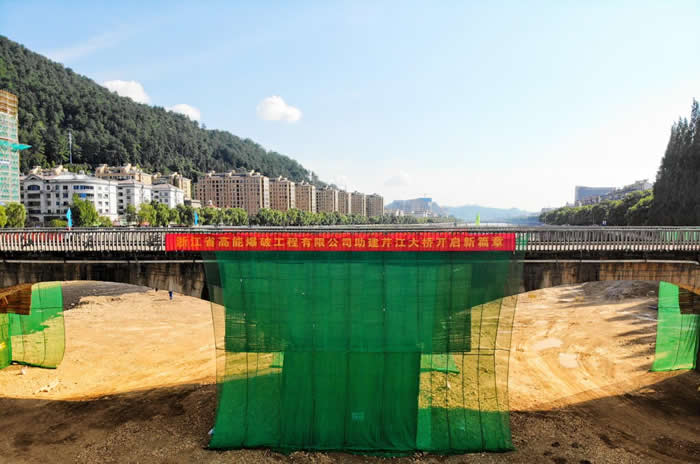
The project required the bridge superstructure to collapse onto the riverbed while ensuring the safety of the surrounding environment, with the bridge piers and foundations sufficiently fragmented to facilitate subsequent construction of the new bridge. To achieve this, the company adopted a “span-by-span precision controlled delay blasting technique.”The method combined deep-hole and shallow-hole drilling: vertical deep holes were drilled in the bridge piers, while vertical shallow holes were drilled at the arch feet of the main arch rings to weaken the key load-bearing sections of each span. Digital electronic detonators were used to achieve “zoned and staged precise delay control,” effectively limiting the harmful effects of blasting, including collapse-induced vibration, within safe ranges.A total of 664 blast holes were drilled for the bridge demolition, using 450 kg of explosives and 800 digital electronic detonators. The blasting design included 26 delay stages, with a total delay time of 700 ms.
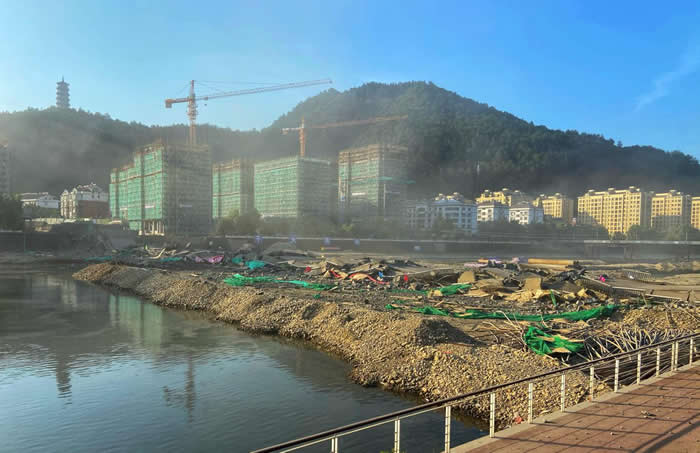
The successful blasting demolition of Qinjiang Bridge received widespread recognition from the Kaihua County Party Committee and County Government, public security authorities, the project owner, and local residents. The project further enhanced the company’s influence in the blasting industry.